
Golf Club Loft and Lie Angles: What They Change and When to Adjust Them
Understand how loft and lie influence launch, distance gaps, turf contact, and starting direction—and why a measured adjustment should follow ball-flight evidence.
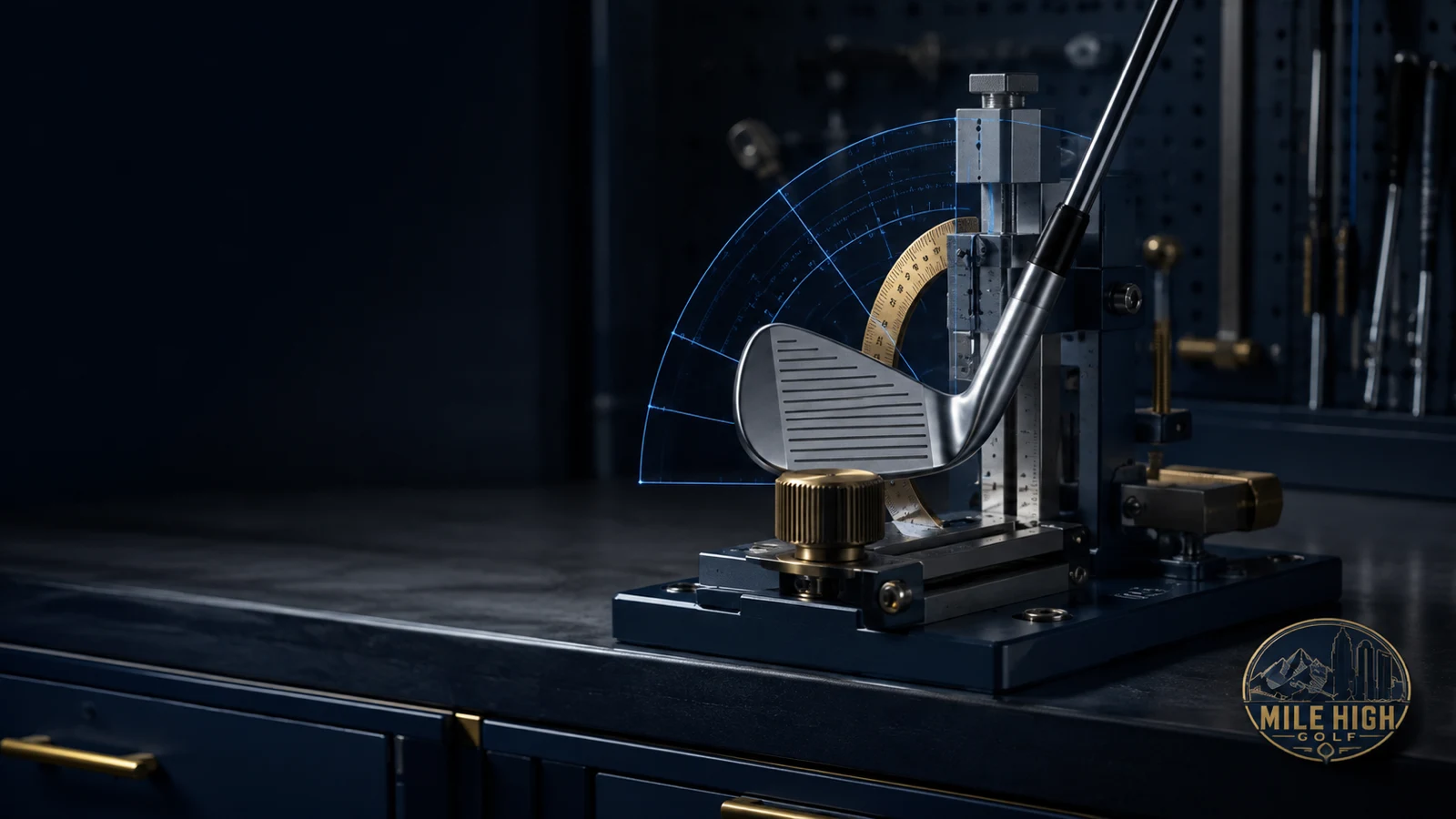
Loft and lie are two small-looking numbers with very different jobs. Loft helps define the launch, spin, trajectory, and distance window a club can produce. Lie describes how the shaft and sole are oriented at address and through impact, and it can influence where the face points when the ball is struck.
Neither specification works alone. Club length, head design, shaft behavior, strike location, delivery, turf interaction, and the golfer's motion all affect the result. That is why a good loft-and-lie check begins with measurements and ball flight—not an automatic decision to bend every club to a chart.
This guide explains what the numbers mean, what changes when they move, how technicians measure them, and when an adjustment is worth considering.
Loft angle: the face's upward tilt
Loft is the angle of the clubface relative to a vertical reference when the club is held in its specified playing position. More loft generally creates a higher-launching, shorter-flying club; less loft generally produces a lower, longer flight. The actual result still depends on delivered loft, speed, strike, face contact, head design, and the ball.
Modern iron model names do not guarantee a particular loft. One manufacturer's 7-iron may differ by several degrees from another's, and even a single model can have optional loft packages. PING, for example, publishes standard, power, and retro loft specifications for current irons and notes that alternative lofts change expected trajectory, spin, and distance gaps. The number stamped on the sole is therefore an identity, not a measurement.
Static loft and delivered loft are different
Static loft is measured on the club. Delivered loft is the effective loft presented at impact after the golfer's handle position, shaft deflection, face orientation, attack angle, and strike are included.
Two golfers can use the same measured 7-iron and produce very different launches. One may deliver the handle forward and reduce loft; another may add loft through impact. A launch monitor can describe the flight, while a loft-and-lie machine describes the tool. Both views are useful.
Lie angle: the shaft-to-ground relationship
Lie angle is measured between the shaft axis and the ground line when the club is in its proper playing position. A more upright lie raises the shaft angle; a flatter lie lowers it.
At impact, lie can affect directional control because loft turns a tilted face into a face that points somewhat left or right of the target. For a right-handed golfer, an impact lie that is too upright can bias the face left; one that is too flat can bias it right. The effect is usually more noticeable in higher-lofted clubs.
That is a tendency, not a complete diagnosis. Club path, face angle, strike location, slope, and motion can create the same pattern. A lie adjustment should not be prescribed from a single pull or push.
PING's official color-code fitting system treats wrist-to-floor and height measurements as a starting point, then directs fitters to evaluate ball flight and golfer feedback. That sequence matters: static dimensions narrow the range, but dynamic evidence confirms the fit.
Loft determines the distance architecture of the set
A well-built iron set should create usable carry-distance gaps, not merely equal loft gaps. Clubhead construction, shaft length, center of gravity, speed, and strike quality can make adjacent clubs fly too close together even when their lofts look orderly.
During a gapping check, record at least:
- measured loft and club length;
- representative carry distance, not the single longest shot;
- launch, spin, peak height, and descent angle when reliable launch data is available;
- strike pattern and turf contact;
- the golfer's intended shot for each club.
If a golfer carries a 7-iron 155 yards and an 8-iron 151, changing loft might help—but inconsistent contact, an unsuitable length progression, or a head/shaft mismatch may be the real cause. The numbers on a launch monitor need a club-spec inspection beside them.
Changing loft can also change sole presentation
On a bendable iron or wedge, changing loft changes how the sole is presented. Strengthening loft typically reduces the effective bounce relationship; weakening loft typically adds to it. Manufacturers account for this interaction in their published specifications. PING's G440 iron specifications, for example, show that bounce values vary across its optional loft configurations.
That matters most when a meaningful loft change alters how the leading edge and sole meet the turf. A distance-gap fix should not create a digging problem. For wedges, where bounce and sole grind are central to performance, the interaction deserves especially careful review.
How loft and lie are measured
A professional loft-and-lie machine holds the clubhead in a repeatable playing position and provides reference scales for both angles. The technician must fixture the head correctly; a careless clamp or inconsistent sole reference can produce misleading numbers.
A sound inspection follows a repeatable sequence:
- Identify the exact head model, shaft, length, and published specification.
- Inspect the hosel, ferrule, shaft, and head for damage or previous work.
- Secure the head according to the machine's procedure without marring the finish.
- Align the scoring lines and face reference consistently.
- Read and record loft and lie before making any change.
- Compare the measured set progression with ball-flight evidence and the fitting target.
- If adjustment is appropriate, bend in controlled increments and remeasure.
- Inspect the hosel and finish after the club is removed.
One measurement is a snapshot. Recording the entire set reveals whether the issue is a single club, a progressive drift, or simply a difference between the golfer's expectation and the manufacturer's specification.
Which clubs can be bent?
Many forged carbon-steel irons and wedges tolerate modest loft-and-lie adjustment when the manufacturer permits it. Some cast heads can also be adjusted within stated limits. Others—especially certain hard alloys, hollow constructions, thin or short hosels, plated finishes, and specialty designs—have tighter limits or may not be suitable.
No responsible technician should promise an adjustment range from appearance alone. Material, construction, hosel geometry, age, prior bending, finish condition, and manufacturer guidance all matter. Bending always introduces stress, and cosmetic marks or structural damage are possible if the head is unsuitable or the requested change is excessive.
Adjustable woods and hybrids use a different system. A hosel sleeve may offer settings that change loft and lie together rather than independently. Titleist's SureFit guide is a good example: the matrix provides combinations, but the correct setting must still be validated through ball flight.
Signs that a loft-and-lie check may help
Consider measuring the set when:
- carry distances bunch together or leave an unexplained gap;
- one iron consistently starts away from the pattern of the rest of the set;
- turf contact is repeatedly heel-heavy or toe-heavy;
- a club has struck a root, mat, cart path, or other hard object;
- a used set has an unknown build history;
- length, shaft, or head components have been changed;
- a golfer's posture, delivery, or physical capabilities have materially changed;
- the set has gone several seasons without a specification check.
Range mats can hide turf clues, and sole marks alone can mislead because the club is moving and rotating through impact. Combine lie tape or marker evidence with centered strikes, face orientation, start line, and representative shots.
What a lie-board mark can and cannot tell you
A mark toward the heel of the sole may suggest an upright dynamic presentation; a mark toward the toe may suggest a flat one. But a lie board can also influence the shot, and the mark reflects the club's interaction with the board after first contact. Modern fitting often supplements or replaces it with face tape, marker-line tests, launch data, and high-speed observation.
The goal is not to force a perfectly centered sole mark at any cost. The goal is predictable impact and ball flight with a club specification the golfer can repeat.
Do not use lie angle to mask a swing pattern
Equipment and motion interact. A carefully chosen lie specification can help a golfer start the ball closer to the intended line, but an extreme bend used to counter a severe path or face problem can produce a club that is difficult to deliver consistently.
A fitter should explain whether a proposed change is:
- matching the club to the golfer's stable delivery;
- restoring a club that has drifted from specification;
- refining a small start-line pattern; or
- compensating for a motion that may be changing.
That distinction protects the golfer from chasing numbers after every lesson or range session.
Rules considerations
The USGA's Equipment Rules treat loft and lie as playing characteristics. A conforming adjustable club may be set before a round, but its playing characteristics generally cannot be deliberately changed during the round. The adjustment mechanism must also lock securely so the club behaves as a fixed unit in play.
For competition, set adjustable clubs before teeing off and carry them in a conforming configuration. The player remains responsible for the equipment used.
A practical loft-and-lie service checklist
Before approving work, ask for:
- before-and-after measurements for every club being adjusted;
- the requested target and why it was selected;
- confirmation that the head model and material are suitable;
- a discussion of loft, bounce, and distance-gap interaction;
- inspection for shaft, ferrule, hosel, and finish damage;
- final verification on the machine and, ideally, with ball flight.
The best result is not “standard.” It is a documented specification that produces useful gaps, predictable start lines, and confident turf interaction for the golfer using it.
Precision before correction
Loft and lie adjustments can be valuable, but the bend itself is the final step—not the diagnosis. Measure the actual clubs, observe the actual shots, choose a modest target, and verify the finished set.
Mile High Golf is building a specialty club-service shop in Denver, North Carolina, for golfers throughout the Lake Norman area. Loft-and-lie measurement and adjustment are coming soon. Until service intake opens, golfers can join the founding list for updates and explore the planned Golf Pro Shop services.