
Golf Grip Size and Regripping: The Connection You Feel Every Swing
A practical guide to golf grip size, texture, taper, wear, buildup tape, and when a full or partial regrip makes sense.
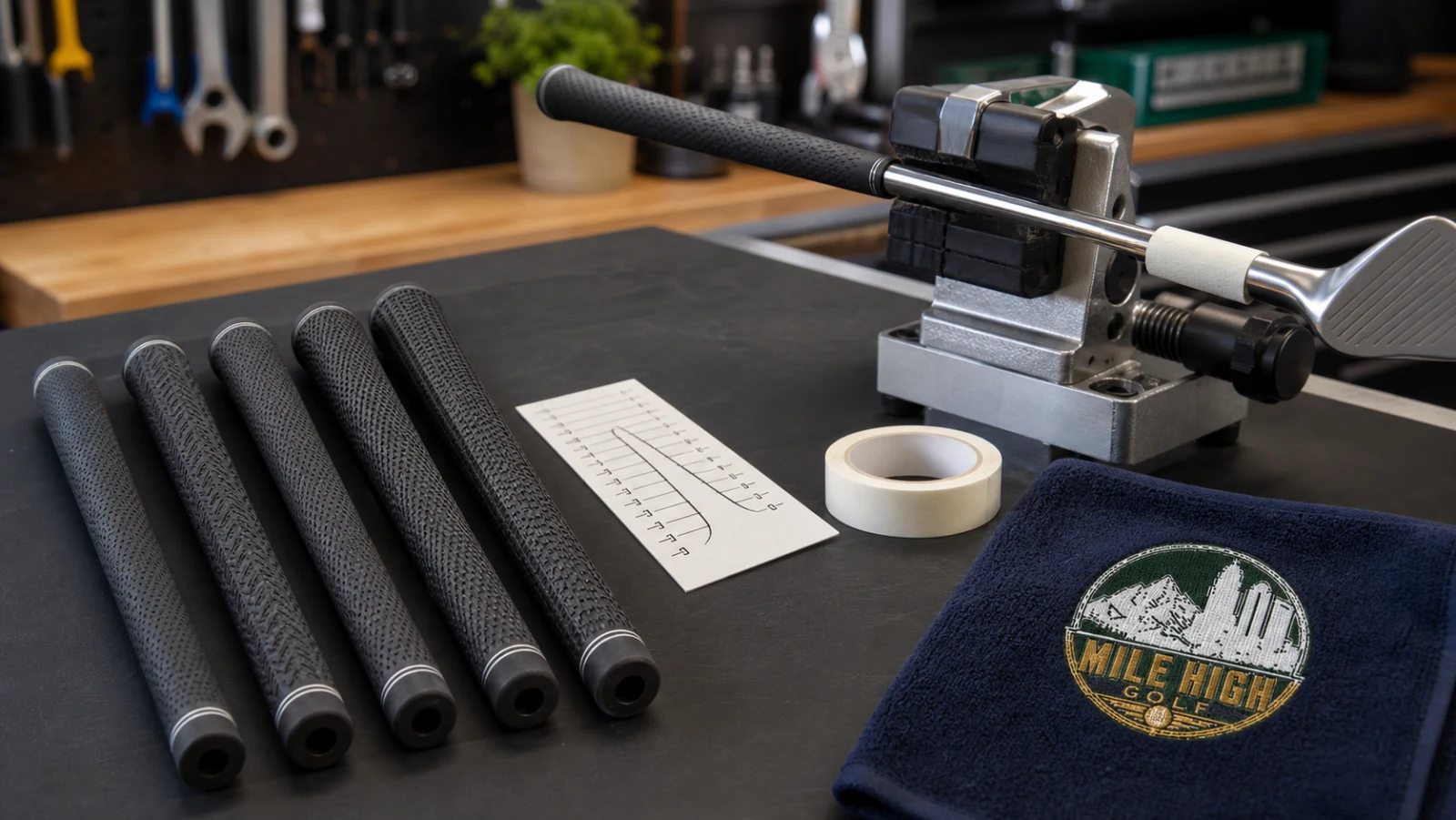
The grip is the only part of the golf club held throughout the swing, yet it is often treated as an accessory chosen by color. In practice, grip size, shape, texture, firmness, taper, condition, and installation all influence how securely and comfortably a player can hold the club.
That does not mean one grip produces the same swing change for every golfer. It means the interface deserves to be selected deliberately. A grip should help the player establish a repeatable hold without excessive squeezing, unwanted movement, or distraction.
This guide explains how golf grip sizing works, why two grips marked “standard” can feel different, when replacement is due, and what a careful regripping process should preserve.
Grip size is more than a label
Manufacturers commonly sell undersize, standard, midsize, and jumbo grips. Those names are helpful starting points, not universal finished measurements.
Golf Pride’s swing-grip size guide uses hand length as an initial screen:
- undersize for roughly 5 to 6.5 inches;
- standard for roughly 6.6 to 7.5 inches;
- midsize for roughly 7.6 to 9 inches;
- jumbo for hands over roughly 9 inches.
Those ranges are manufacturer guidance, not a law of fitting. Glove size can provide another starting point. The final choice should also consider finger length, hand shape, pressure sensitivity, normal weather, and what the player can hold consistently.
A familiar checkpoint is to take a normal lead-hand grip and see where the middle and ring fingers meet the heel pad. Golf Pride suggests that they should barely touch. A visible gap can indicate a grip that is too large for that hand position; fingers digging deeply into the pad can indicate one that is too small. This is a useful observation, but comfort and repeatability still matter more than forcing every hand into one picture.
Why two “standard” grips may not finish the same
The installed diameter is created by a system: shaft butt size, grip core size, grip wall construction, tape, stretch, and installer technique.
Shaft butt diameter
Golf shafts do not all have the same outside diameter under the grip. Two clubs fitted with the same grip can therefore finish differently if their butt sections differ.
Grip core size
The core size is the inside diameter for which a grip is designed. Installing a grip over a larger or smaller shaft butt changes the final stretch and outside diameter. The model name alone does not tell the entire story.
Buildup tape
Additional wraps of tape can create sizes between retail categories or reduce taper in a selected area. The result depends on tape thickness, coverage, overlap, and where each wrap ends. “Two extra wraps” is meaningful only when the shop uses a repeatable method.
Stretch
Pulling a grip farther down the shaft can make it longer and slightly thinner. Inconsistent stretching is one reason a set may feel mismatched even though every grip came from the same box.
A good work order records the grip model, nominal size, core size when relevant, tape specification, number and placement of buildup wraps, logo orientation, and finished length.
Size can change how the hands respond
Golfers commonly describe a smaller grip as more active in the fingers and a larger grip as quieter in the hands. Those descriptions can be useful during testing, but they are not guaranteed ball-flight prescriptions. Swing response depends on the golfer, the full club, and the task.
The better fitting questions are more direct:
- Can the player place the hands naturally without forcing them open or closed?
- Can the club be held securely with reasonable pressure?
- Does the player feel slipping, twisting, crowding, numbness, or fatigue?
- Is the preferred size repeatable across the set?
- Does the player need a different solution for the putter than for full-swing clubs?
Golfers with arthritis, reduced hand strength, injuries, or hand sensitivity may prefer a larger or softer-feeling grip because it can be easier to hold. That is an individual comfort decision and not medical treatment; players managing pain should involve an appropriate healthcare professional.
Taper, texture, firmness, and moisture control
Diameter is only one part of feel.
Taper
Traditional grips narrow toward the shaft. Reduced-taper designs keep more material under the lower hand. Tape can also build the lower section. Some players prefer the fuller lower-hand feel; others prefer a traditional taper. The useful question is whether the shape supports a repeatable hold.
Texture and pattern
Surface pattern affects traction and feedback. A pronounced pattern or cord can feel secure in heat, rain, or humid conditions, while a softer rubber pattern may be more comfortable for bare hands or dry weather. Gloves, hand moisture, cleaning habits, and sensitivity all influence the choice.
Firmness
A firmer grip can communicate more vibration and resist deformation. A softer grip can feel cushioned but may encourage some players to squeeze if it feels unstable. Neither is universally superior.
Moisture management
Moisture, sunscreen, skin oils, dirt, and worn glove material can reduce traction. A grip selected for a humid Lake Norman summer may reasonably differ from one selected for an indoor-only set. Golf Pride’s product and features guidance recommends considering texture, playing conditions, moisture control, size, and taper together.
When should golf clubs be regripped?
There is no single calendar that fits every golfer. Frequency of play, range practice, storage temperature, ultraviolet exposure, hand oils, cleaning, and grip material all affect wear.
Golf Pride recommends replacement at least yearly for many golfers, depending on use, and often frames approximately 40 rounds as a general benchmark. Treat that as a maintenance reminder—not an expiration date. A golfer who practices several times a week may wear grips faster, while a lightly used indoor set may age differently.
Physical condition is the better decision tool. Look for:
- glossy or slick contact areas;
- hardened rubber that no longer feels resilient;
- cracking, crumbling, or frayed cord;
- obvious thumb wear or a flattened pattern;
- a grip that twists or moves on the shaft;
- persistent loss of traction after proper cleaning;
- inconsistent feel between clubs in the same set.
Golf Pride’s grip-wear guide highlights glossiness, hardening, crumbling, and concentrated thumb wear as common warning signs.
Clean first, then judge
Sometimes a dirty grip is mistaken for a worn-out grip. Cleaning can remove oils and residue, restore some surface traction, and make the remaining condition easier to assess.
Follow the grip manufacturer’s care guidance. For many rubber grips, a mild soap, water, a soft brush or cloth, thorough rinsing, and air drying are reasonable. Avoid harsh solvents, petroleum products, or excessive heat unless the manufacturer specifically allows them. Cord, leather, polymer, and specialty surfaces may require different care.
Cleaning cannot reverse hardening, replace lost texture, repair splits, or correct a loose bond. If the surface remains slick or structurally damaged after cleaning, replacement is the appropriate maintenance step.
Full-set consistency versus selective replacement
Replacing every grip at once creates the most consistent model, size, tape build, and wear state. That is often the best choice when the entire set is old or when the player is intentionally changing specifications.
Selective replacement can still make sense when:
- one frequently used club has worn faster;
- a damaged grip needs immediate attention;
- the player is testing a new size or model on one club;
- wedges use a deliberate, different texture or lower-hand profile;
- a putter requires its own shape and fitting decision.
If only part of a matched set is replaced, record what changed. Otherwise, a gradual mix of models and builds can create uncertainty later.
Regripping can affect club measurements
A grip has mass. Changing from a light model to a much heavier one can change the club’s measured swingweight even though the head has not changed. Some manufacturers use a rough workshop convention of about one swingweight point for every four grams added at the grip end, but the actual reading and the player’s sensation are not identical concepts.
The practical lesson is simple: if a player is sensitive to club balance, record the old and new grip mass and measure the club rather than assuming the change is invisible.
Grip length and tape should also be consistent. A build that is unintentionally stretched, short, lumpy, or misaligned can be felt long before it is noticed visually.
What a careful regrip includes
1. Document the current setup
Record the club, shaft, existing grip model and size, orientation, and any visible buildup. Note damaged shafts or loose components before removal.
2. Remove the old grip safely
Steel and graphite shafts require different care. Cutting toward a graphite shaft can damage fibers. The club should be supported without crushing or marking the shaft.
3. Remove old tape and inspect
A clean shaft allows the new grip to seat evenly. The installer should inspect for corrosion, dents, cracks, or residue that would compromise the installation.
4. Build to a written specification
Apply the specified tape consistently, including any lower-hand buildup. Use compatible installation materials and keep liquid away from vulnerable labels or components.
5. Align and finish consistently
Logo-up, logo-down, or a reminder feature must be aligned to the intended clubface position. Finished grip length and end-cap seating should match across the set.
6. Allow adequate cure time
Solvent-installed grips need time before use. Golf Pride’s installation FAQ recommends waiting at least four hours. Cure time can vary with materials, temperature, and method, so the installer’s instructions govern pickup and play.
Are all grip shapes legal?
For clubs other than putters, the USGA grip rule generally requires a fixed, straight, plain grip with a circular cross-section, subject to permitted features such as a continuous reminder rib or slightly indented spiral wrap. Putter grips have additional shape allowances. The rules also regulate dimensions and construction.
Most mainstream grips are designed with these requirements in mind, but unusual builds, strong reminder features, molded hand positions, or improvised modifications deserve review if the club will be used in competition. The USGA’s Rule 4 interpretations provide more detail.
A simple grip-fitting conversation
Before choosing, bring one club you like and one you do not. Explain where you play, whether you wear a glove, how your hands respond in heat or rain, and whether pain or fatigue affects your hold. Compare at least two sizes and textures in an address position. If the difference is significant, test on one club before changing the entire set.
The best grip is not the newest or most aggressive-looking one. It is the grip specification the player can hold comfortably, align consistently, and trust in the conditions where the club is actually used.
Mile High Golf is building a specialty club-service shop in Denver, North Carolina, serving golfers around Lake Norman. Regripping intake will open with the shop. Until then, join the founding list for opening updates and visit the planned Golf Pro Shop to learn about the service approach.