
Golf Shaft Flex, Weight, and Torque: How to Fit the Whole Profile
A detailed guide to shaft flex, weight, torque, bend profile, balance point, and length—and why a complete fit matters more than a single letter.
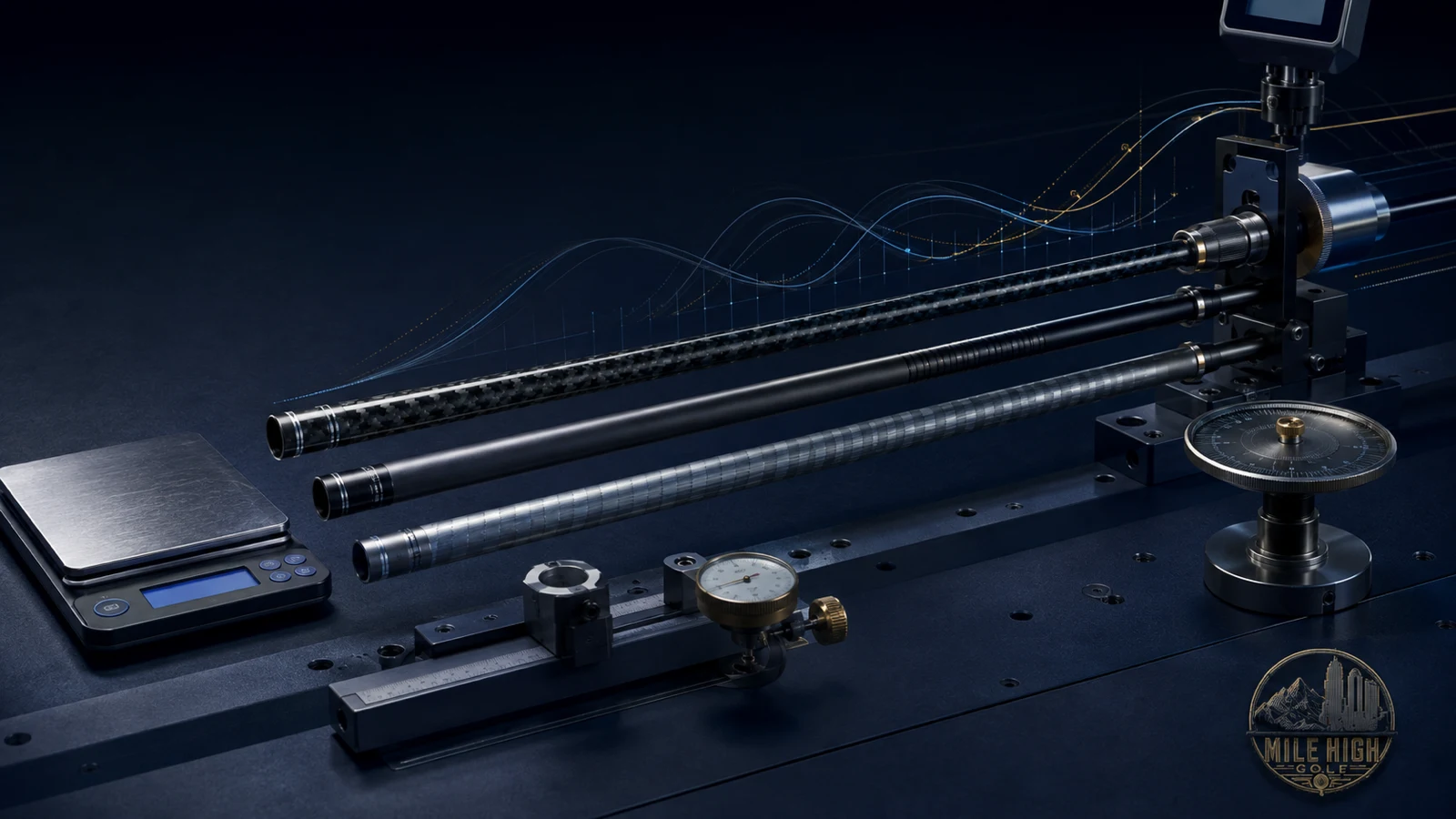
A shaft label compresses a complex structure into a few characters: 60 S, 5.5, X, R, or something proprietary. Those labels are convenient, but a golfer does not swing a letter. The player feels a shaft's mass, how stiffness is distributed from butt to tip, how it twists, where it balances, and how the complete club behaves at its finished length.
That is why “What flex do I need for my swing speed?” has no reliable one-line answer. Speed is relevant, but so are tempo, transition, release, strike, delivery, desired flight, total weight, head mass, and feedback from the golfer.
This guide explains the major shaft variables and a practical way to evaluate them without mistaking marketing categories for a complete fit.
Flex is a category, not the full bend profile
Flex describes resistance to bending, commonly expressed with labels such as L, A, R, S, and X or with a numerical system. The label is useful inside a manufacturer's model family, but it does not describe every section of the shaft.
Two shafts labeled “stiff” may have different:
- actual weight;
- butt-section stiffness;
- mid-section stiffness;
- tip stiffness;
- torque;
- balance point;
- length and trimming instructions;
- response under a particular golfer's load.
Manufacturer specification tables make this visible. Fujikura's official shaft specifications list flex beside weight, tip flex, butt flex, torque, bend point, launch, and spin. The existence of all those columns is the lesson: flex is one coordinate in a larger design.
What golfers mean when they say a shaft feels “soft” or “boardy”
Feel is personal. A shaft may feel soft because the handle section moves during transition, because the tip releases noticeably, because the total club is light, or because head weight makes it load more. “Boardy” may describe a profile the golfer cannot sense, a weight that disrupts tempo, or simply an impact feel they dislike.
Frequency measurements can compare clubs under a defined clamp and tip-weight setup, but one cycles-per-minute number does not reconstruct the entire bend profile. It is most useful when the test method is consistent and the technician understands what portion of the shaft is being compared.
Shaft weight often changes the swing before impact
Weight affects the golfer's ability to sense, accelerate, and return the club. A lighter shaft may help some golfers create speed or reduce fatigue. A heavier shaft may improve awareness, rhythm, and strike stability for others. Either direction can backfire if the golfer loses the club during transition or must manipulate it to find the face.
Separate three related measurements:
- shaft weight: the component's mass before assembly;
- total club weight: head, shaft, grip, adapter, ferrule, tape, and other parts together;
- swingweight: a balance-index measurement describing how the club's mass is distributed relative to a fulcrum, not the club's total mass.
Two clubs can share a swingweight and feel very different because their total weights and balance points differ. Likewise, installing a lighter shaft does not guarantee a lighter-feeling head. Build length, shaft balance point, grip weight, and head weight all influence the final result.
Torque describes resistance to twisting
Shaft torque is a measured amount of angular twisting under a specified load, usually reported in degrees for graphite shafts. Lower numbers indicate less measured twist under that manufacturer's test; higher numbers indicate more.
Torque can influence feel and the shaft's response during the swing, but it should not be treated as a direct dispersion score. The golfer does not apply a perfectly isolated laboratory load, and manufacturers can use different test methods. Head properties, face contact, bend profile, speed, and delivery all matter.
Within a single family, specification tables show how torque changes across weight and flex. Fujikura's tables, for example, list different torque values among VENTUS models and weights, while Mitsubishi Golf publishes weight, torque, and kick-point data for products such as VANQUISH. Those numbers are most useful for comparing known products and confirming build targets—not declaring that one number fits every golfer.
Bend profile: where the shaft resists and releases
A shaft does not bend as a single hinge. Designers tune stiffness along its length. The butt, mid, and tip sections can each be comparatively firm or active, creating an EI profile—a map of bending stiffness along the shaft.
Broad tendencies are often described this way:
- a firmer handle can feel stable during transition;
- a softer midsection can feel as though it loads more readily;
- a firmer tip can reduce the sensation of tip movement;
- a softer tip can increase that sensation and may influence delivered loft for some golfers.
These are tendencies, not guaranteed ball-flight commands. A golfer's timing and delivery determine how the design is used. Fujikura's SPEEDER NX documentation discusses 3D motion-capture analysis and variable torque as design tools, illustrating why a modern shaft cannot be reduced to “high launch” or “low spin” ink on a label.
Balance point and counterbalancing
Balance point describes where the shaft's mass is concentrated. A higher-balance-point or counterbalanced shaft carries relatively more mass toward the grip, which can give a builder room to use more head weight or a longer assembly while managing swingweight. A lower balance point can make the head feel more present.
This variable matters when changing driver length, using heavier adapters, selecting oversized grips, or rebuilding an iron set. If the new shaft moves the balance point substantially, matching the old swingweight alone may not recreate the old feel.
Length changes more than distance from the ball
Playing length affects posture, strike pattern, speed potential, lie presentation, total weight, and swingweight. A longer club generally raises swingweight unless other components change; a shorter club generally lowers it. Builders may add or remove head mass to reach a target, which then changes how the shaft is loaded.
Trimming also matters. Parallel-tip iron shafts, taper-tip sets, and wood shafts follow different manufacturer instructions. Tip trimming can alter the working section of some designs; butt trimming sets finished length. Improvised trimming can create a club unlike the one represented by the shaft label.
Driver shafts and iron shafts solve different problems
A driver shaft operates with a long build, light head relative to an iron, high clubhead speed, and a large modern head with meaningful aerodynamic and inertial properties. The fitting emphasizes strike, face delivery, launch, spin, speed, and dispersion.
Iron shafts must also support consistent length progression, total-weight flow, turf contact, launch windows, distance control, and repeated strikes across a set. Steel and graphite can both be excellent. Material alone does not dictate quality, flight, or player type.
True Temper's Project X steel specifications publish flex, weight, dimensions, and launch/spin positioning across models. Fujikura's graphite iron tables publish weight, tip and butt flex, torque, and bend point. Compare complete specifications and ball-flight outcomes, not stereotypes about materials.
Swing speed is an input, not a prescription
Clubhead speed helps establish the load and performance window. It can rule out obviously unsuitable options. But two golfers at the same speed may need different shafts because one has a gradual tempo and late release while the other has a forceful transition and earlier release.
A useful fitting also considers:
- tempo and transition force;
- release pattern;
- attack angle and delivered loft;
- face-to-path and start-line pattern;
- centeredness and consistency of strike;
- peak height and descent angle;
- fatigue across a session or round;
- the golfer's ability to feel and time the club;
- desired flight and course demands.
The fitter should look for a repeatable group of good shots, not the fastest single swing.
A structured shaft-fitting process
1. Measure the current club
Record playing length, total weight, swingweight, loft/lie context, grip size and weight, shaft model and flex, and any tipping or build notes. Establish a baseline with representative shots.
2. Define the problem
Is the golfer seeking speed, tighter strike, different flight, less fatigue, better feel, or a replacement for a damaged component? A shaft cannot solve every launch problem, and a vague goal invites random testing.
3. Test weight first in a sensible range
Weight can alter tempo and contact immediately. Compare options close enough that the golfer can make normal swings. Watch strike location and dispersion, not only speed.
4. Refine profile and flex
Within a workable weight range, compare bend profiles and flexes. Look for a club the golfer can load without forcing and return without rescuing. Capture both numbers and comments; feel can explain why a statistically good option will or will not survive on the course.
5. Validate the entire build
The test shaft, adapter, head setting, length, and head weight must resemble the proposed finished club. Otherwise the delivered build may not reproduce the fitting result.
6. Recheck after assembly
Verify finished length, loft/lie where relevant, total weight, swingweight or balance target, grip size, orientation, and clubhead security. Then confirm flight and strike.
Common shaft-fitting mistakes
Buying a flex label across brands
An S in one model is not a promise that another S will feel or perform the same. Use the label within its product context and compare measured specifications.
Chasing the lowest launch or spin at all costs
Launch and spin must support carry, peak height, descent, and control. A shot that looks powerful in a fitting bay may be less playable on the course.
Ignoring the grip and head
Grip weight, grip build-up, adapter, head weight, and hosel setting all change the assembled club. A shaft fitting that ignores them is incomplete.
Testing while fatigued
As speed and delivery degrade, the apparent winner can become the option that merely compensates for tired swings. Use breaks, alternate candidates, and stop when the data no longer represents normal play.
Treating a shaft as a swing correction
A shaft can complement delivery and change feel, but it cannot guarantee a square face or centered strike. Separate equipment fit from instruction while recognizing that each affects the other.
Equipment and build safety
The USGA Equipment Rules require a conforming shaft to be straight from the grip to near the sole and to bend and twist consistently when tested in equivalent directions. Club playing characteristics must remain fixed during a round.
From a repair standpoint, graphite deserves controlled extraction and preparation. Excess heat, crushing clamps, or sanding into structural fibers can damage a shaft. Reuse should follow inspection and manufacturer-compatible procedures; a cosmetically clean tip is not proof of structural integrity.
Fit the system, then document it
The best shaft is not the one with the most expensive material story or the strongest letter. It is the component that lets a golfer deliver a well-balanced club repeatedly, creates the intended strike and flight, and can be built to the measured specification that was tested.
Mile High Golf is building a specialty fitting and club-service shop in Denver, North Carolina, for golfers around Lake Norman. Shaft fitting and build intake are coming soon. Golfers can join the founding list for opening updates and explore planned Golf Pro Shop services.