
Laser Engraving and Wedge Resurfacing: What Golfers Should Know
A technical guide to golf club laser engraving, wedge face resurfacing, groove work, design placement, and the rules questions golfers should ask.
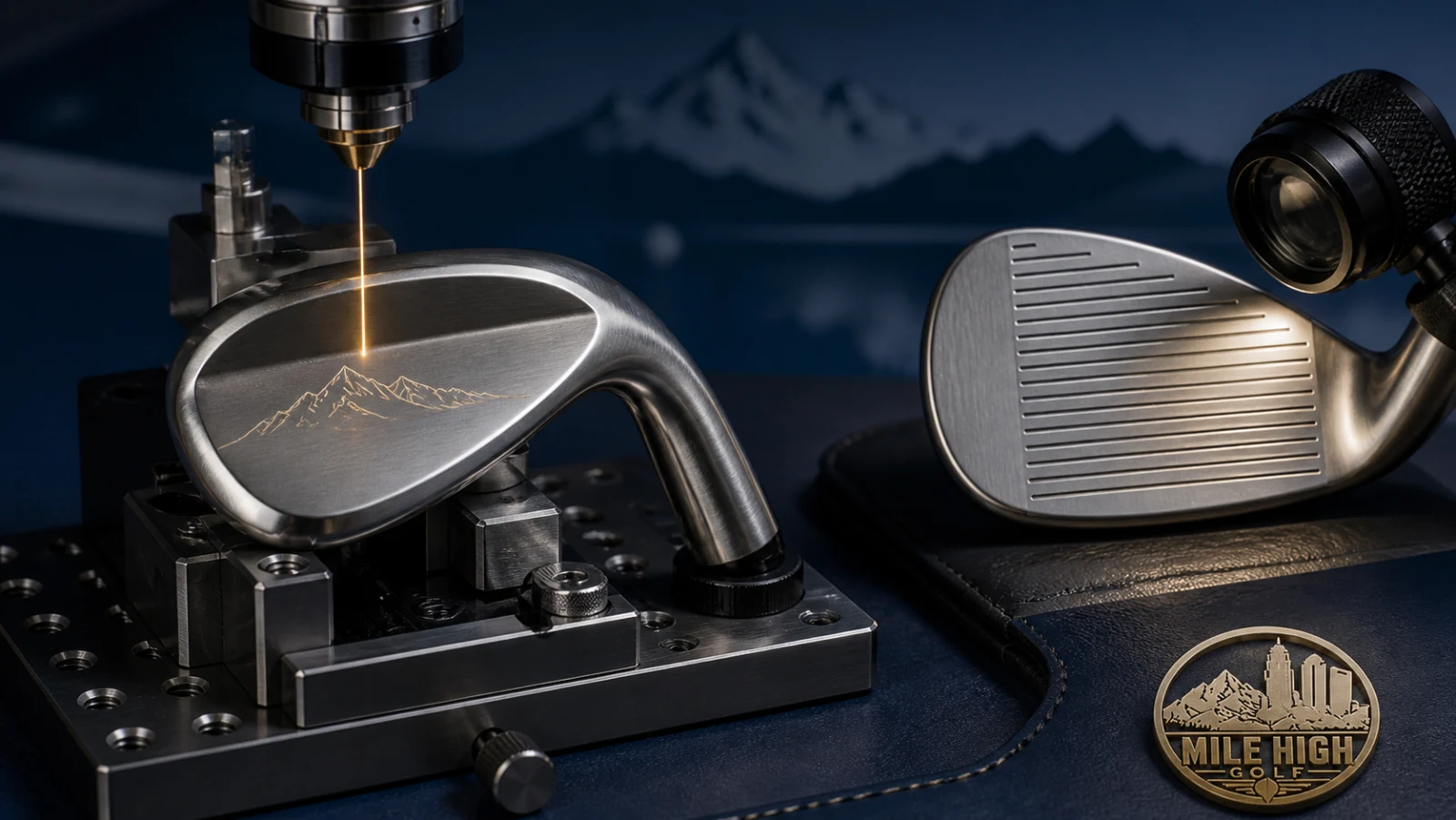
A golf club can carry a story and still remain a serious piece of equipment. A name, a tournament date, a small piece of artwork, or a restored wedge face can make a club feel personal again. But laser engraving and wedge resurfacing are not the same operation, and neither should be treated like printing a logo on a flat sign.
One process is primarily about controlled marking. The other can change the working face of the club. That difference matters for appearance, durability, play, and—if the club will be used in competition—equipment-rule compliance.
This guide explains what actually happens at the clubhead, what a careful shop should inspect, and which questions a golfer should answer before approving the work.
Laser engraving is a family of processes
“Laser engraving” is often used as a catch-all phrase, but a laser can interact with metal in several distinct ways.
- Engraving removes a small amount of material by melting or vaporizing it, leaving a recessed mark.
- Annealing or color marking heats suitable metals and creates an oxide layer with little or no material removal.
- Ablation or cleaning removes a coating, paint, oxide, or other surface layer while trying to leave the base metal largely intact.
Industrial laser manufacturer TRUMPF distinguishes these processes because the material, finish, depth, contrast, and desired durability determine the correct approach. Its technical overview notes that annealing is suited to steel and titanium, while engraving removes material. See TRUMPF’s explanation of annealing and its marking-laser process guide.
For a golf club, that means a shop should identify the substrate and finish before choosing settings. Stainless steel, carbon steel, titanium, plated finishes, black oxide, paint-filled cavities, and coated components do not all react the same way. A setting that produces a crisp mark on one wedge may discolor, strip, or overheat another finish.
A golf club is not a flat blank
Clubheads create three practical challenges: curved surfaces, reflective metal, and tightly controlled functional areas.
Focus and fixture control
A laser has a limited focal range. If a clubhead rocks in the fixture or a design crosses a steep curve, the mark can lose sharpness or change character. A stable, repeatable fixture helps keep the target area at the intended angle and distance. Rotary or multi-axis positioning may be useful on rounded shapes, but the design still has to respect the club’s geometry.
Heat and finish response
Laser energy is concentrated. The operator has to balance power, pulse behavior, speed, spacing, and the number of passes. More energy is not automatically better. Excess energy can widen a line, create an uneven edge, change nearby color, or damage a coating.
Artwork that survives reduction
Fine gradients, tiny lettering, and thin negative spaces can look excellent on a screen but fail when reduced to a small metal surface. Strong engraving artwork usually has clear silhouettes, intentional line weight, adequate spacing, and a defined minimum size. A proof should show the actual placement and approximate scale—not merely the artwork by itself.
Where engraving belongs on a club
Placement is both an aesthetic and a functional decision. Common decorative locations include a wedge’s back cavity, a flat portion of a putter, or another non-impact area with enough room to fixture and focus safely.
The hitting face deserves special caution. The USGA club-face rule regulates grooves, punch marks, roughness, and features that could influence the ball. Decorative markings outside the impact area may be acceptable when they do not influence ball movement, but a decorative idea should never be allowed to become an unreviewed face modification.
A careful approval should therefore specify:
- the exact club and material;
- the exact surface to be marked;
- the finished dimensions and orientation;
- whether the mark will be recessed, surface-colored, or paint-filled;
- whether competition use matters to the customer.
Personalization should also be checked for ownership and authorization. A shop should not reproduce protected logos or other artwork merely because a file was supplied.
What wedge resurfacing actually means
Wedge faces wear unevenly. Repeated contact, sand, dirt, moisture, bag chatter, and corrosion can change the appearance and texture of the face. “Resurfacing” may describe several levels of work, so the scope should be written plainly.
Cleaning and inspection
The first step is not cutting—it is inspection. Dirt and oxidation can hide damage. The shop should look for excessive wear, deep gouges, cracks, loose heads, shaft or ferrule issues, and a face that may already have been altered. Cleaning can reveal whether the club needs cosmetic attention, measured groove work, or retirement.
Finish or surface preparation
Light surface work may remove residue, oxidation, or a failing finish. Depending on the club, this can expose a different base-metal color and change how quickly the surface develops patina or rust. It can also remove factory markings or protective coatings. The customer should know which changes are expected and which are irreversible.
Groove work
Groove work is not simply “making the lines sharp again.” The rules evaluate measurable geometry: width, depth, spacing, consistency, and edge shape. The USGA’s groove and punch-mark guidance explains why appearance alone cannot establish conformity.
The USGA’s Rule 6 interpretations also distinguish light refurbishment toward original condition from deliberate re-grooving. A deliberately altered or re-grooved club must meet the applicable current specifications, and specialized measurement may be needed to determine that. In other words, a clean-looking face is not automatically a conforming face.
Resurfacing cannot make every wedge “new”
Metal removed from a club cannot be put back by polishing it. Deep dings, substantial face wear, corrosion pits, and previous aggressive work set limits on a restoration. A responsible shop should decline work when the remaining material, condition, or unknown history makes the result too uncertain.
There are also tradeoffs:
- Removing a finish can change appearance and corrosion behavior.
- Aggressive face work can change geometry or head mass.
- Sharpening without measurement can create nonconforming edges.
- A cosmetic improvement does not guarantee a specific spin result.
- Older or collectible clubs may lose originality and value when altered.
For a favorite gamer, a practical refurbishment may be worthwhile. For a historically important or valuable club, preservation and documentation may matter more than making it look new.
Competition use changes the conversation
Golfers often ask, “Will this still be legal?” That question cannot be answered responsibly from a photograph alone.
The USGA equipment rules address the face as a system, not just the visible groove outline. Its equipment FAQ discusses groove geometry and surface roughness, including limits on decorative blasting and very fine milling. If tournament conformity is important, tell the shop before any face work begins. The operator can then document the club, limit the proposed scope, explain uncertainty, or recommend formal evaluation.
Recreational use and competition use are different customer goals. A recreational golfer may knowingly choose a cosmetic or performance-oriented alteration that would require additional review before tournament play. The important point is that the choice is explicit.
The right workflow before a laser fires
A disciplined engraving or resurfacing job should include six checkpoints.
1. Identify the club
Record the manufacturer, model, loft or club number, finish, handedness, and any visible serial or identifying marks. Photograph the club’s condition before work.
2. Define the outcome
“Make it better” is not a specification. Is the goal a permanent name, a gift design, renewed appearance, removal of corrosion, or measured face work? Each goal calls for a different process.
3. Confirm material and finish
When the material or coating is uncertain, a hidden-area test or a conservative refusal may be smarter than guessing.
4. Approve placement and scale
Use a visual proof on a photo or template of the actual club. Confirm orientation as the golfer will see it, especially on putters and wedges with asymmetrical cavities.
5. Protect functional areas
Fixture the club securely, keep the beam path controlled, and isolate areas that should not be marked. Industrial lasers can create serious eye, skin, and fire hazards; OSHA and the FDA both emphasize controlled use of higher-powered systems. See OSHA’s laser hazards overview and the FDA’s laser safety FAQ.
6. Inspect and document the result
Check alignment, consistency, edge quality, finish response, and any agreed measurements. Photograph the completed club before pickup.
Questions to ask before approving the work
- What exact process will be used: engraving, annealing, coating removal, surface cleaning, or groove cutting?
- What material and finish is the clubhead?
- Is the design positioned outside the functional impact area?
- Will any original coating, stamping, plating, or paint fill be removed?
- Does the golfer plan to use the club in governed competition?
- What result can be promised, and what remains uncertain until the surface is tested?
- Is replacement a better value than extensive work on a badly worn head?
These questions protect both the club and the expectation.
A better kind of customization
Good customization does not fight the design of the club. It uses the available surface, preserves important geometry, and turns a personal idea into a mark that looks intentional. Good resurfacing is similarly restrained: inspect first, define the goal, remove only what the process requires, and document any rules implications.
Mile High Golf is building an on-site specialty club-service shop in Denver, North Carolina, serving the Lake Norman area. Laser engraving and wedge-service intake will open with the shop. Until then, golfers can join the founding list for opening updates or review the planned laser engraving and wedge services.
This article is educational and is not a ruling that a particular modified club conforms to the Rules of Golf. Competition questions may require evaluation under the applicable governing-body procedures.