
Wedge Bounce and Grind Explained: Match the Sole to Your Swing and Turf
Learn how wedge bounce, sole width, camber, and grind work together—and how swing delivery, turf, sand, and face manipulation shape the right fit.
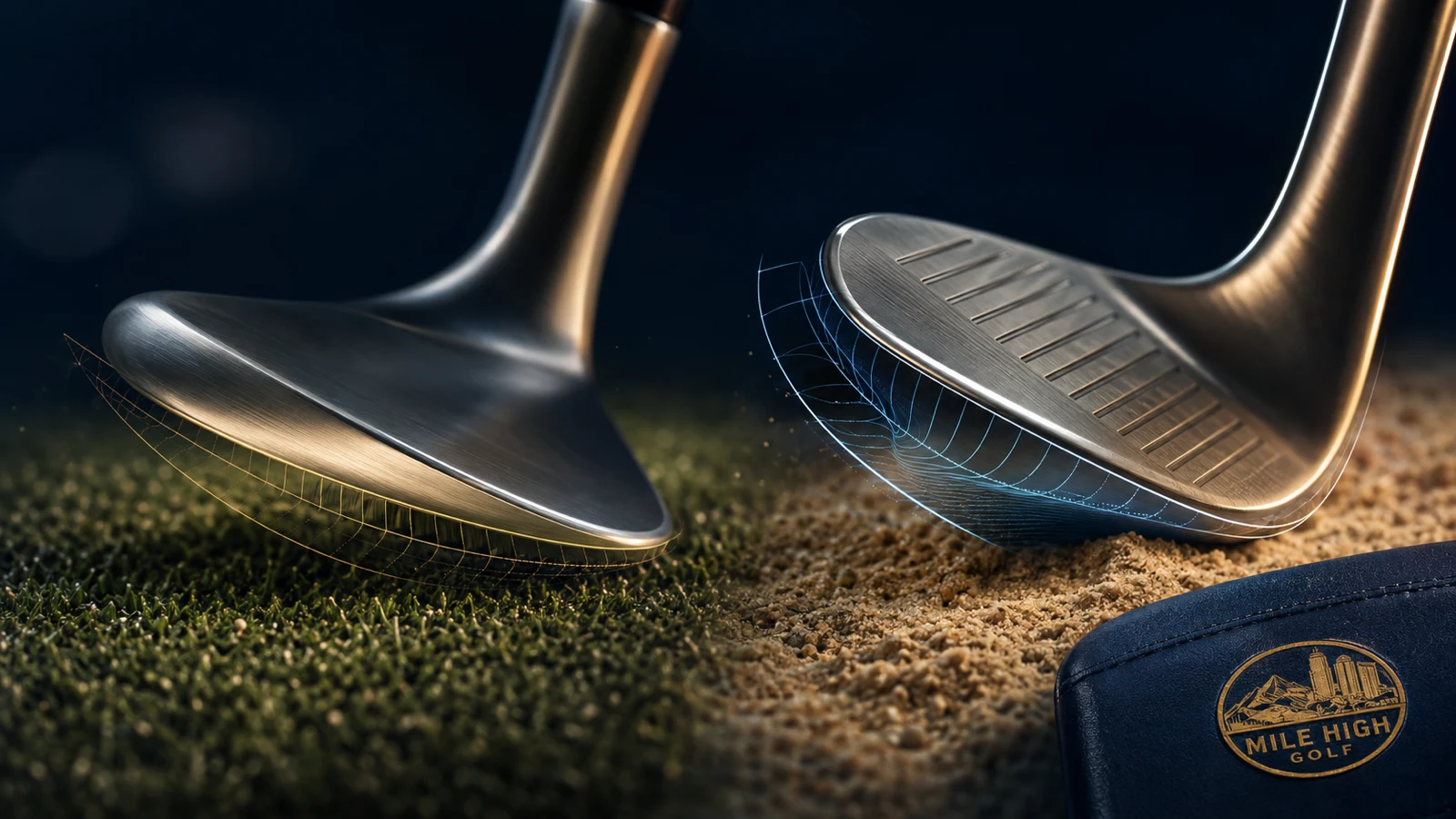
Wedge loft gets most of the attention, but the sole is what meets the ground. Bounce, width, camber, leading-edge shape, and heel or trailing-edge relief determine how that sole enters and exits turf or sand. The right combination can give a golfer room for a slightly heavy strike; the wrong one can make a familiar shot feel unusually difficult.
“High bounce for diggers, low bounce for sweepers” is a useful first sentence. It is not a complete fitting. A player can be steep on a square-faced full swing and shallow on an open-faced pitch. Firm Bermuda, dormant winter turf, soft overseeded ground, fluffy sand, and compacted bunkers all change the problem.
This guide separates bounce from grind and shows how to fit the whole sole to the shots a golfer actually plays.
What wedge bounce means
Measured bounce angle is the angle between the leading edge and the lowest point of the sole when the club is held in its defined position. More measured bounce generally places more sole below the leading edge; less bounce generally presents the leading edge closer to the ground.
Bounce is often described as resistance to digging. That is accurate, but the number stamped on the wedge does not describe the whole sole. Two 10-degree wedges can behave differently because one has a narrow sole with strong camber and relief while the other has a wide, fuller sole.
Vokey's official wedge bounce guide frames the fit around swing type and conditions: higher bounce tends to suit steeper delivery and softer ground, while lower bounce can suit shallower delivery and firmer conditions. The guide also emphasizes versatility and shot preference, which is where grind enters the discussion.
What “grind” actually describes
Grinding removes and shapes material from selected areas of the sole. Common locations include:
- heel relief, which can reduce how much the leading edge rises when the face is opened;
- toe relief, which changes contact in open-face or toe-down shots;
- trailing-edge relief, which can help the sole exit after initial contact;
- leading-edge shaping, which changes entry and visual presentation;
- sole-width and camber shaping, which influence how quickly the club engages and releases from the surface.
Manufacturers give grinds letters or names, but those labels are proprietary. An “M,” “C,” or “S” from one family should not be assumed to equal a similarly named grind elsewhere. Compare the actual geometry, available loft/bounce combinations, and intended shots.
Vokey's loft, bounce, and grind overview describes grind as sole shaping used to improve turf contact and provide different shot-making options. That definition is more useful than treating grind as a cosmetic feature.
Measured bounce versus effective bounce
Measured bounce is one reference angle. Effective bounce is how the sole behaves in a particular shot. It changes with:
- sole width;
- front-to-back and heel-to-toe camber;
- face angle;
- shaft lean;
- attack angle;
- handle height;
- turf or sand firmness;
- strike location and speed.
A wide sole can provide substantial resistance to digging even with a moderate stamped bounce. A narrow sole with relief can play lower when the face is opened. A golfer who leans the shaft forward reduces the loft and changes the sole presentation; adding loft by opening the face generally exposes more bounce unless heel relief keeps the leading edge down.
This is why buying from a bounce number alone is risky.
The three delivery questions
1. How deep is the golfer's typical divot?
A steep delivery and deep divot usually benefit from more sole support. The club needs enough bounce and/or width to keep moving rather than burying. A shallow delivery that brushes the surface may prefer less bounce or more relief, especially on firm turf.
2. How is the face used?
A player who keeps the face square for most chips has different needs from one who regularly opens it for height and softness. Opening the face changes the leading-edge height and activates different parts of the sole. Heel relief can preserve versatility without removing all the bounce from square-faced shots.
3. What miss needs protection?
If the common miss is heavy, more effective bounce can add forgiveness. If the common miss is bladed from tight lies because the leading edge feels too elevated, a narrower or more relieved sole may inspire better contact. Technique still matters, but the sole can either widen or narrow the acceptable impact window.
Turf conditions around Lake Norman
Golfers in the Carolinas can encounter dramatic seasonal changes. Warm-season grasses may be dense and supportive in summer, thin or dormant in winter, wet after storms, and firm during dry periods. Courses may overseed selected areas, while practice facilities and mats offer another surface entirely.
No single wedge is perfect for every lie. Fit for the conditions and shots that matter most, then build enough versatility into the rest of the wedge setup. A player who travels may deliberately blend soles—for example, a fuller sand wedge for soft bunkers and a more relieved lob wedge for firm turf and open-face shots.
Sand is not one condition
“Bunker wedge” is not a universal category. Consider:
- soft, deep sand: more effective bounce and sole width can keep the head from digging too deeply;
- firm or shallow sand: too much exposed sole may cause the club to rebound into the ball, so less bounce or a different technique may be required;
- wet, compacted sand: the surface can behave closer to firm turf;
- steep bunker faces: loft and the ability to open the face become more important;
- long bunker shots: a stable sole that preserves speed can matter more than maximum loft.
Test with the actual bunker technique. A golfer who enters well behind the ball and uses the sand differs from one who takes a shallower, more direct path.
Loft gapping comes before collecting grinds
The wedge set must cover distance and shot roles. Begin with the true loft of the shortest iron, then identify carry gaps into the scoring clubs. A common four- to six-degree progression is only a starting point; swing speed, launch, head construction, and shot style determine the usable distances.
Assign each wedge a job:
- full and three-quarter approaches;
- low checking pitches;
- standard chips;
- soft open-face shots;
- firm or soft bunkers;
- rough and awkward lies.
The most-played wedge may need the broadest versatility, while a specialty wedge can be optimized for a narrower job.
How changing loft changes the sole
Bending a wedge weaker or stronger does more than alter distance. It changes the relationship between the leading edge and sole, affecting effective bounce. Weakening loft generally adds bounce; strengthening generally removes it.
The exact result depends on the head and bend, so the finished club should be measured. Large changes can also affect offset, face presentation, gapping, and turf behavior. Select the closest appropriate head specification before using bending as a substitute for the correct loft/bounce model.
A practical wedge-fitting session
A useful session includes more than full shots from a perfect mat.
Establish the baseline
Record each wedge's measured loft, length, lie, swingweight or total-weight context, and sole model. Hit enough normal shots to identify carry, launch, spin window, strike, and dispersion without chasing a single best swing.
Test multiple lies
Use, where safely available:
- a tight fairway lie;
- ordinary fairway turf;
- light rough;
- soft ground;
- firm and soft sand;
- uphill and downhill lies.
Repeat the golfer's real shots
Ask for square-face chips, partial pitches, flighted approaches, open-face shots, and bunker shots. Observe entry point, divot depth, leading-edge height, strike location, exit, and the golfer's confidence.
Change one variable at a time
Comparing completely different wedges can hide the reason for improvement. When possible, test similar lofts with different bounce/grind options, then similar soles with different lofts. Vokey's wedge fitting guidance likewise directs attention to divots, turf, ball flight, and preferred shots rather than a single static number.
Common bounce and grind mistakes
Choosing only by handicap
Handicap does not reveal attack angle, course conditions, or shot preferences. Skilled players may use high bounce aggressively; newer players may need a versatile sole rather than the lowest possible leading edge.
Copying a tour setup
Tour players choose for their delivery, speed, preparation, and course. Their ground conditions and technique may have little in common with a golfer's weekly round.
Equating low bounce with “better from tight lies”
Low bounce can help on firm, close-cut ground, but it also reduces protection from a heavy strike. Sole width, camber, and relief may provide a better compromise than simply selecting the smallest number.
Ignoring wear
Groove and face wear receive attention, but sole wear can also change edges and surface interaction. Inspect wedges that have seen extensive bunker practice or abrasive soil.
Regrinding without a complete plan
Removing sole material changes weight, balance, finish, geometry, and potentially durability. A custom grind should begin with a measured target and enough material—not an improvised attempt to copy another model.
Rules and maintenance
Conforming wedges must meet the USGA's equipment requirements for clubhead form and face features. The USGA Equipment Rules also require playing characteristics to remain fixed during a round. Custom sole work intended for competition should preserve a traditional, conforming head shape and should be evaluated when there is doubt.
Keep grooves clean during practice and play, dry the head after wet conditions, and inspect the face, sole, ferrule, and shaft regularly. A wedge's performance is a system; bounce cannot compensate for damaged grooves, a loose head, or inconsistent contact.
The goal: predictable interaction, not a magic number
The right wedge gives the golfer useful options while protecting the common miss. That fit may be high bounce with relief, moderate bounce on a wider sole, or low bounce in a specialized firm-turf tool. The answer comes from the delivered club and the surface, not from the stamp alone.
Mile High Golf is building a specialty club-service and fitting shop in Denver, North Carolina. Wedge evaluation and club-service intake are coming soon. Golfers can join the founding list for opening updates and review planned Golf Pro Shop services.