
Adjustable Driver Settings: Make One Change You Can Actually Test
Understand your driver's adjustment chart, record a baseline, and compare settings without chasing one unusually good shot.
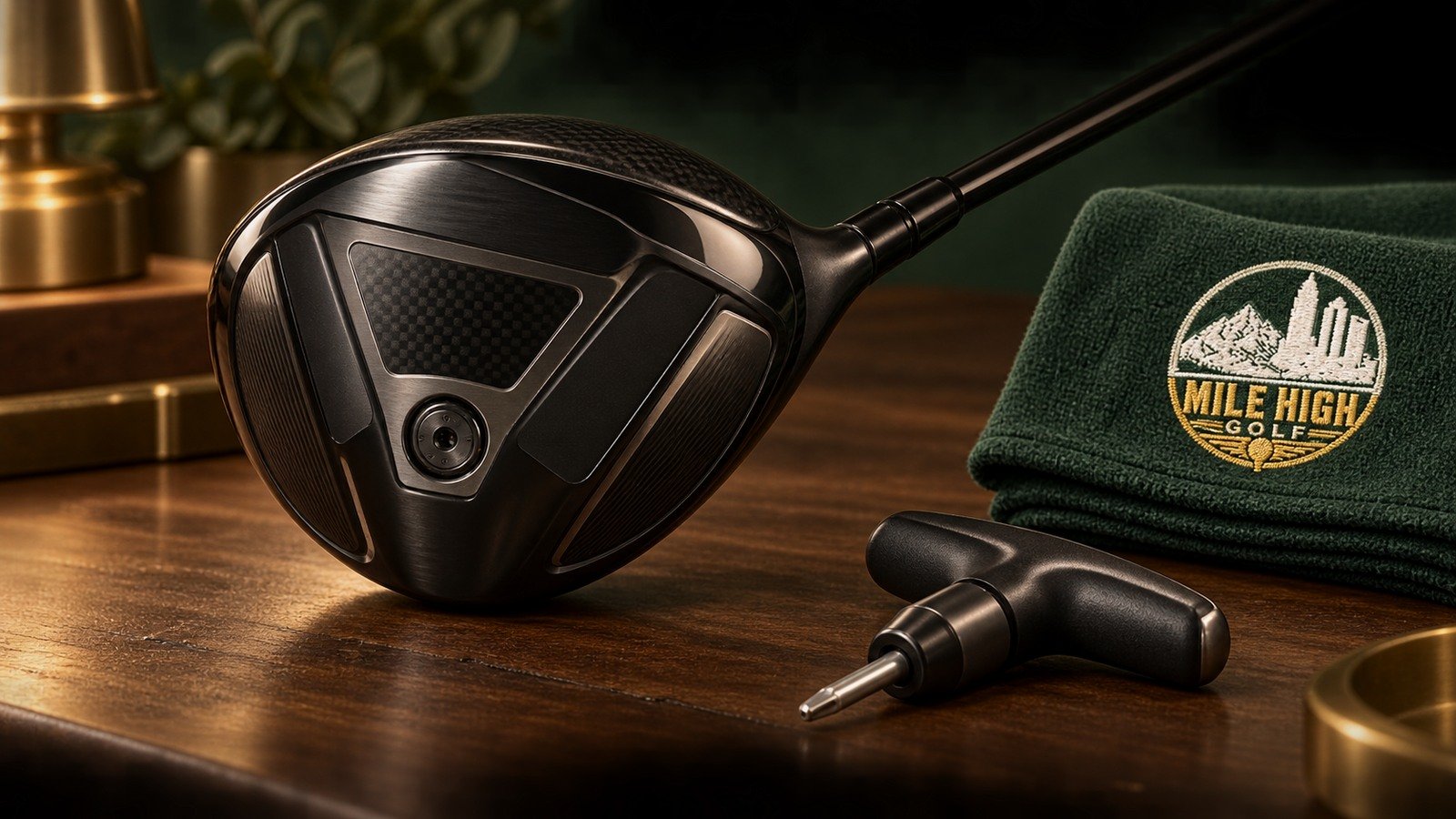
The adjustment sleeve on a driver is an invitation to experiment. It is also an easy way to lose track of what changed. A better session starts with the exact model's instructions, a record of the original setting, and one question you want the comparison to answer.
Perhaps your flight is difficult to keep in play. Perhaps you want to compare a different launch window. Write that down before touching the wrench. If the goal changes after every swing, the experiment will not tell you much.
Find the correct chart before loosening anything
Identify the head, adapter, handedness, and compatible tool. Similar-looking sleeves can use different markings and adjustment ranges. A chart for a hybrid or a different manufacturer's driver is not a substitute for your model's instructions.
Titleist's SureFit guide is a clear manufacturer example: its sleeve and ring provide 16 combinations, with different starting positions for right- and left-handed clubs. Its listed driver/fairway increments differ from its hybrid increments. The page describes loft as effective loft with a square face at impact. Do not transfer those settings or assumptions to another system.
Photograph your current setting and note any movable-weight position before making a change. Keep the manufacturer's chart available at the bench. If the parts do not match the documentation, resolve that first with the maker or a qualified fitter.
Separate the adjustment from the result
The chart describes an equipment configuration. It does not promise that your next shot will fly a specific distance or finish on a specific side. Your delivery and contact still matter. Trackman's club-data definitions distinguish measured delivery variables such as face angle and dynamic loft from simple catalogue specifications.
This is why a setting called draw, upright, or higher should become a testable hypothesis rather than a guarantee. Keep the wording in your notes precise: “testing the maker's higher-loft setting” is better than “adding ten yards.”
Establish a useful baseline
Warm up before collecting comparison shots. Use the same ball model, target, tee arrangement, and launch-monitor environment throughout. If the monitor offers normalized conditions, record whether they are enabled; do not compare one set with normalization and another without it.
Choose a target corridor that resembles a tee-shot decision you face. Record the starting direction, finish pattern, carry, and obvious strike problems. Use the carry-distance guide for a fuller discussion of interpreting ranges instead of celebrating your longest shot.
Our suggested test design is an editorial checklist, not a manufacturer-prescribed fitting protocol. The number of useful shots depends on consistency, fatigue, and whether the device captures valid data. A qualified fitter can adapt the session.
Change one variable, then return to baseline
- Save or label the baseline group with its actual setting.
- Make one manufacturer-supported setting change outside a rules-governed round.
- Keep the ball, target, and measurement settings consistent.
- Hit another comparable group and keep ordinary misses in the record.
- Return to the starting configuration for a final comparison if time and comfort allow.
That last step helps reveal whether you warmed up, tired out, or changed your delivery while testing. It is not laboratory proof, but it is more informative than assuming every difference came from the sleeve.
Do not change the shaft, movable weight, ball, tee height, and hosel setting simultaneously if you want to understand the hosel's contribution. If a fitter changes several things to find a workable overall setup, record that honestly as a complete-system comparison.
Read the whole pattern
| Observation | Useful next question |
|---|---|
| One very long drive among several wide misses | Did typical usable results improve? |
| Tighter finish pattern with slightly less carry | Does that tradeoff suit the hole or course? |
| Higher flight but inconsistent contact | Did strike location change between groups? |
| Better first group, worse later group | Did fatigue or setup drift affect the trial? |
| Missing or implausible monitor values | Is the capture setup valid before interpreting it? |
Trackman's face-to-path explanation connects face orientation relative to the club's path with expected curvature, subject to impact conditions. A sleeve label alone cannot diagnose a slice. If the contact and delivery pattern remain unclear, a fitting or coaching assessment is a better next step than cycling through every setting.
Use the tool as the manufacturer directs
For SureFit specifically, Titleist instructs golfers to tighten until the appropriate wrench clicks and to stop and realign if the screw binds. That is model-specific guidance, not a universal torque specification. Follow the exact instructions for your equipment, including compatibility and tool requirements.
Stop if a component will not seat properly, a thread feels wrong, or you find damage. Do not force a joint or improvise a repair to finish the test. Record the final setting and check that the assembly is secure as directed before use.
Know the rule before the round
USGA Rule 4.1a(3) restricts making a stroke with a club whose playing characteristics you deliberately changed during the round, including through an adjustable feature. The rule contains specific provisions and exceptions; consult the current rule or your Committee for a particular incident. Treat a between-round fitting session and a competition round as different situations.
Keep the setting that earns its place
Write a short conclusion: the original configuration, the alternative, what improved, what worsened, and which you chose. If the result is inconclusive, keep the baseline and revisit it under more consistent conditions. There is no requirement to use a setting simply because it is available.
For related equipment context, read our shaft weight, flex, and torque guide. Mile High Golf is coming soon in Denver, NC; this article does not announce current service availability. Join the founding list for opening updates.
Primary sources reviewed September 21, 2026: Titleist SureFit guidance, Trackman definitions and face-to-path education, and USGA equipment rules. The comparison method is editorial judgment. Hero image is an AI-generated editorial illustration.