
How to Be a Great Scramble Partner at Any Skill Level
Bring a reliable shot, a clear plan and the right questions. This first-scramble checklist helps every teammate contribute without pretending every outing uses the same rules.
You do not need to be the longest hitter to be a useful scramble partner. Know the event's rules, tell your team which shots you trust, stay ready, and help the group choose a playable next shot. A dependable contribution can be a ball in play, a clear observation or a well-kept scorecard.
If a friend has invited you to a charity outing and your first thought is that you will hold everyone back, start here: ask what format you are actually playing. In a typical scramble, teammates each hit, choose one result, and play their next shots from that selected location under the event's placement rules. Repeat the process toward the hole. You are helping build a team score rather than finishing every hole with your own ball.
That familiar outline leaves plenty unanswered. A two-player outing, a four-player fundraiser and an elimination scramble can have different requirements. This guide offers an original preparation checklist and team decision card, not a universal set of scramble rules. Sources were checked October 26, 2026.
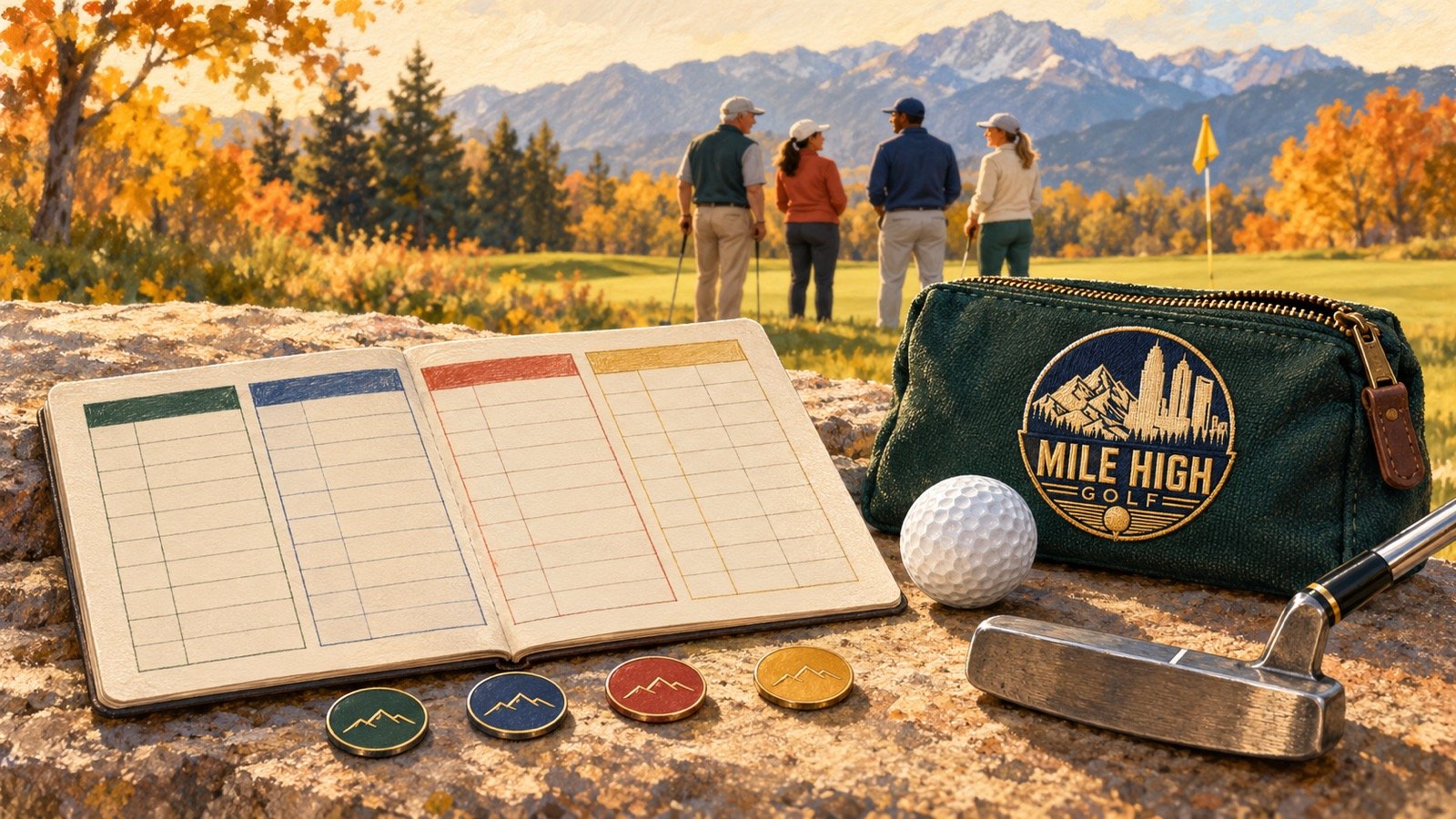
Hero: AI-created editorial artwork incorporating the official Mile High Golf logo. The golfers, course and equipment arrangement are imagined; this is not a photograph of our venue or an actual event.
Get the organizer's sheet before choosing a strategy
The event's written instructions should settle the details that friends sometimes remember differently. Ask the organizer about an unclear rule before the round, and keep the answer with the scorecard. Do not borrow a convenient rule from another outing.
For a concrete example, the PGA of Canada's PGA Scramble rules distinguish their four-amateur local format from later five-player elimination stages. Their local rules include a minimum of three selected tee shots per player and a specific two-putt provision. Those are that program's conditions, not automatic permissions at your charity event. The example shows why the word “scramble” is only the beginning of the conversation.
Use this checklist at registration:
| Ask the organizer | Record the answer before teeing off |
|---|---|
| Which tees does each player use? | Assigned tees, including any age or other eligibility conditions |
| Where may we place the next ball? | Allowed distance, no-nearer requirement and restrictions on changing the lie or area of the course |
| What happens in bunkers or penalty areas? | The event's procedure, placement restrictions and who to contact for a ruling |
| Must each player's drives count? | The exact minimum, any exceptions and how selected drives must be recorded |
| Does the player whose shot is chosen sit out? | Whether this is an elimination or step-aside variation, and when the restriction ends |
| Are mulligans or other extras allowed? | Quantity, permitted uses and how they are recorded; assume none without permission |
| When is a hole finished? | Holing-out requirements, any maximum-score provision and whether any putt may be conceded |
| How is the result submitted? | Gross or net scoring, the organizer's handicap calculation, scorecard approval and deadline |
This is a question list, not a replacement rules sheet. A blank answer is a reason to ask, not a license to improvise. In particular, do not turn a ball in the rough into a fairway lie simply because someone remembers “one club-length.”
Give your team an honest introduction
Skip the apology tour. A useful introduction sounds like: “My short iron is more dependable than my driver, and I am comfortable putting first.” That gives teammates information they can use. You do not need to assign yourself a permanent rank.
Before the first tee, agree who will record scores, who will track any required drives, and who will make the final choice when the group is split. One person can handle more than one job. Share the rules sheet so the scorekeeper is not the only person who knows what the team promised to follow.
Bring the ordinary things you need for the conditions: your clubs, identifiable balls, tees, a ball marker, a pencil, water and suitable clothing. Confirm the course's own arrival and equipment requirements. There is no need to buy a new club just to look ready for a team round.
If you are unsure what a club reliably carries, use an honest range rather than your longest-ever shot. Our carry-distance guide explains how to build useful distance windows. At the outing, “usually enough to reach the front” is more helpful than an optimistic number that leaves everyone guessing.
Choose the next shot the team can actually play
The closest ball is not automatically the best choice. Compare the lie, the angle to the target, obstacles and the shots your teammates can repeat. A shorter ball with a clear view may give the group more useful attempts than a longer ball blocked by a tree.
PGA Life Member Sam Adams makes this team-comfort point in the SCGA's scramble strategy guide: choose a manageable next shot for the group, and recognize that the strongest player can differ by part of the game. That is professional playing advice, not a rule or a guaranteed scoring formula.
Our suggested conversation takes three questions:
- Is this option allowed? Check the selected ball's location and the event's procedure.
- What does it leave? Name the lie, target, trouble and likely next shot.
- Who can play it comfortably? Choose with the whole team in mind, including any drive requirement.
Imagine two hypothetical drives: one is farther forward but on an awkward slope; the other leaves a longer approach from level ground. There is no automatic winner. If most of the team struggles from the slope, the level option deserves serious consideration. If a selected-drive requirement matters, bring that into the decision now rather than discovering it on the last tee.
Use an order that helps people commit
A hitting order should make the job clearer. It should not become a public ranking of everyone's ability. Ask who prefers an early attempt and who benefits from seeing a result first. Revisit the order when the shot changes or the event's rules require it.
SCGA's guide suggests getting a dependable tee shot into play before asking a longer hitter to take on more risk. Treat that as one available strategy. The practical point is to know whether the team already has a usable result before changing the next player's task.
Keep the request specific: “We have a playable ball; choose the shot you are comfortable trying.” Do not turn a teammate's safe result into pressure to attempt a shot you have never practiced. Agree on a target, then let the player make the swing without a committee of last-second tips.
Make putting observations useful
Before the first putt, settle the intended starting line and pace. Afterward, describe what happened: “It finished short and moved right near the hole.” Avoid declaring that a miss proves everyone's next putt must use the same adjustment. Starting line and speed both affect what you saw.
Let the next player decide how to use the information. Stay out of the player's view and line, keep equipment clear, and give them room to prepare. Encouragement is useful; a running swing lesson usually is not.
Do not assume a short putt is conceded or that you can tap in while other teammates continue trying from the original spot. Follow the event's completion procedure. If there is uncertainty, ask an official before an action changes the team's options. For a separate practice day, our 10-minute putting game offers a way to work on distance control without turning the outing into a lesson.
Save this team decision card
This is Mile High Golf's original organizing tool. It is not an official scorecard and does not change any event rule.
| Moment | One useful action |
|---|---|
| Before the round | Put the rules sheet, selected-drive tracker and organizer contact in one place |
| Before each tee shot | Check assigned tees and whether a particular player's drive still needs to count |
| Before selecting a ball | Compare playable lies and next-shot options before comparing distance |
| Before moving or placing balls | Confirm the chosen location and the permitted procedure |
| After the hole | Agree the team score and record the selected drive immediately |
| Before submitting | Check totals, required drives and the organizer's approval instructions together |
Keep preparation moving without hurrying someone through a stroke. Be ready with your club when it is your turn, watch shots from a safe position, and follow the course's cart and pace instructions. Never hit toward a group that is still within reach merely to recover lost time.
Leave with one habit worth keeping
After the round, ask which small habit helped most. Maybe the team stopped losing track of required drives. Maybe a beginner found a shot they were happy to hit. Maybe everyone got better at saying what they saw without giving unsolicited instruction.
Choose one of those habits for next time. A successful first scramble does not require pretending you played perfect golf. It means understanding the event, contributing honestly and being someone the group would enjoy inviting again.
Mile High Golf is a planned indoor-golf and specialty club-service venue in Denver, NC. Bookings and customer service intake remain unavailable. Join the founding list for confirmed updates, or send this checklist to your group before its next outing.
Sources and scope
- PGA Scramble presented by BMW: official event rules — organizer-specific examples of format, drive requirements and hole completion. These conditions are not rules for an unrelated event.
- SCGA: Best Strategies for Scramble Tournaments, by Sam Adams — professional judgment about team roles and selecting playable shots. Published in 2016; reviewed as strategy, not current event authority. We do not adopt its separate advice about extra putts after holing out; follow your organizer's practice restrictions and pace expectations.
The registration checklist, three-question decision process, hypothetical comparison and team decision card are original editorial tools. No scoring improvement, event eligibility, venue availability or handicap result is promised.
Be first through the door.
Planned opening February 2027, subject to approvals.