
A 10-Minute Putting Game for Better Distance Control
Three starting spots, nine scored putts and one honest record of where the ball stopped. Give your next short practice session a useful purpose.
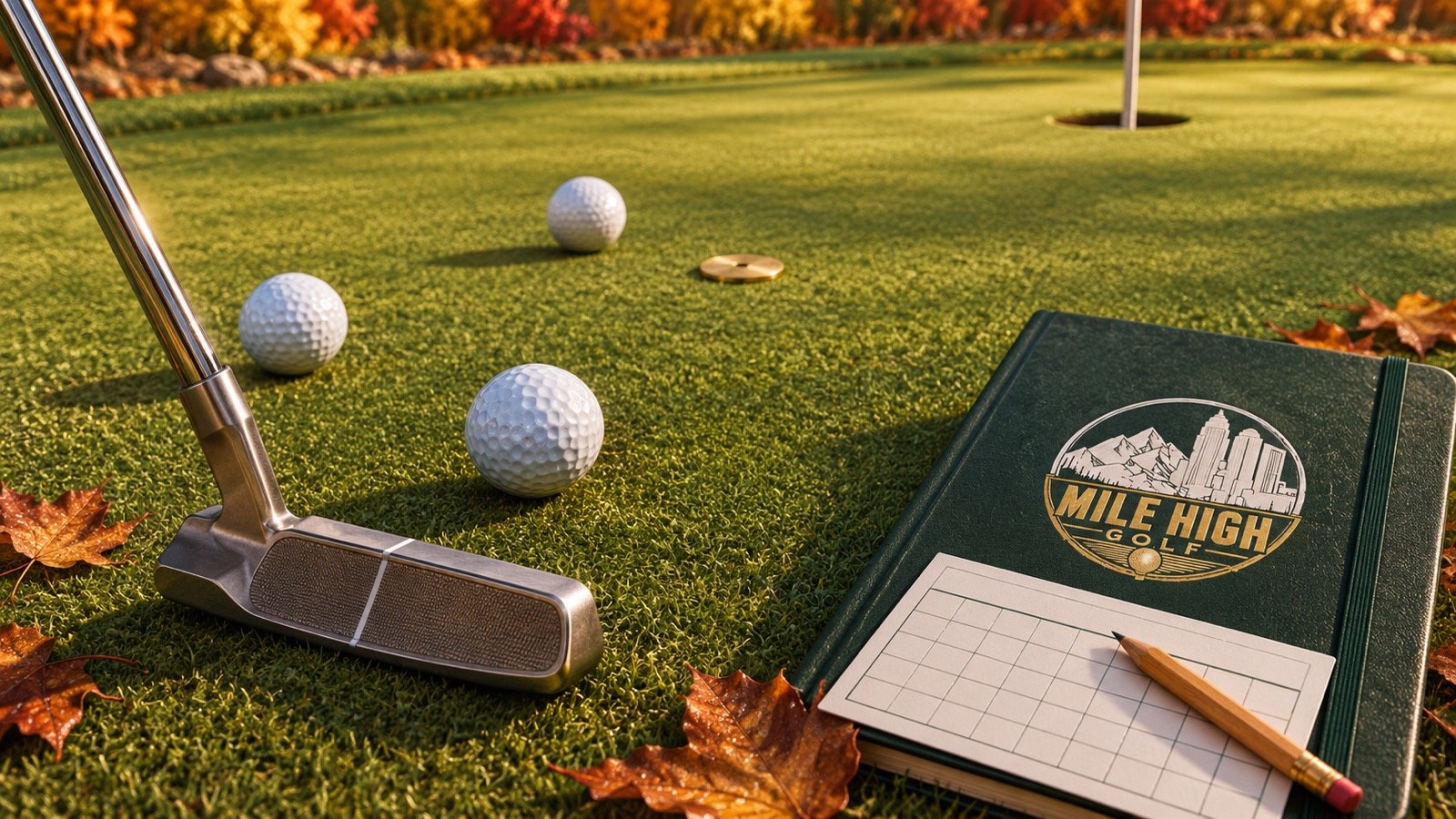
To practice putting distance control in about ten minutes, choose a flat target, mark three starting distances and score nine putts by how close they finish. Record short, long, left and right misses as well as points. Repeat the same setup another day before deciding what improved.
A short practice session needs a question it can answer. For this one, the question is simple: can you send the ball different distances and leave it close to your chosen spot? You do not need a new putter, a bucket of balls or a promise that a drill will remove three strokes from your score.
This game is for the recreational golfer with a little time before a round, the beginner learning pace and the friend who wants a challenge without an eighteen-hole score. It is an original Mile High Golf editorial exercise. The distances, scoring bands and nine-shot sequence below are practice choices, not a validated skills test or a PGA benchmark.
Hero: AI-created editorial artwork with the Mile High Golf logo. The autumn putting green and practice notebook are imagined, not a photograph of our venue or an exact setup diagram.
Why measure the finish instead of counting makes?
A putt that stops beside a target and one that races several feet past it can both miss a hole. A simple make-or-miss tally hides that difference. Recording the finish gives you another way to describe the attempt.
PGA of America instruction offers useful context. Trish Holt's lag-putting lesson emphasizes speed and distance control on longer putts. Keith Stewart's box drill uses a stopping area as a practice target. Those are coaching resources; the scoring system here is our own way to organize a small session, not their drill reproduced under a different name.
Keep direction in the record too. Finishing the right distance but well to one side is different from rolling straight toward the target and stopping far short. Neither pattern alone diagnoses your stroke. Slope, aim, contact and pace can interact.
Set up one safe, simple lane
Use a permitted practice putting surface with enough room to putt without crossing another player's line. Ask the facility before placing markers, and keep the lane clear. Use a flat coin or approved flat marker as your target, away from a cup, so a holed ball cannot hide its stopping distance. Avoid a raised object that acts as a backstop.
Choose a reasonably level section for your first comparison. Put starting markers 6, 12 and 18 feet from the target. Measure with a tape if convenient. If you use paces, write down that the lengths are approximate and reuse those same starting spots. There is no benefit in pretending a pace is an exact foot.
Bring a putter, one to three balls, a pencil and the scorecard below. Use the same ball model throughout when practical. Retrieve each ball after recording its finish; a ball left beside the target can stop or deflect the next attempt. A single ball works perfectly well and naturally slows the exercise down.
On a short home mat, use 3, 5 and 7 feet instead, provided the surface allows the ball to roll beyond the target without meeting a return ramp or wall. Label it a home-mat version. Its results are not directly comparable with the longer outdoor setup. PGA instructor Brendon Elliott also describes practice from different starting distances in his at-home putting guide; follow the space you actually have.
Play the nine-putt game
Allow roughly two minutes to set up and roll three unscored familiarization putts, one from each start. Use the next six minutes for the nine scored attempts. Leave the final two minutes to total the card and write one observation. Ten minutes is a planning target; take longer if measuring or collecting balls needs it.
Play in this order:
- Round one: 6 feet, 12 feet, 18 feet.
- Round two: 12 feet, 18 feet, 6 feet.
- Round three: 18 feet, 6 feet, 12 feet.
Use your normal preparation for every attempt. Change the starting distance as listed rather than rolling nine balls from one comfortable spot. Count every scored attempt, including the mishit you would prefer to erase. Keep warm-up balls out of the scored total.
Measure from the target's center to the ball's center after it stops. Award 2 points within 12 inches, 1 point beyond 12 inches through 24 inches, and 0 points beyond 24 inches. Exactly 12 inches earns 2; exactly 24 earns 1. The maximum is 18 points. These circles are convenient scoring bands, not claims about an easy next putt or a recommended tournament putting strategy.
Copy this scorecard
Record the miss relative to the line from that attempt's starting spot to the target. Use S for short, L for long, Lt for left and Rt for right. Combine them when useful: S/Rt, for example. A ball can earn points and still have a direction worth noting.
| Attempt | Start distance | Leave distance, inches | Direction | Points |
|---|---|---|---|---|
| 1 | 6 ft | — | — | — |
| 2 | 12 ft | — | — | — |
| 3 | 18 ft | — | — | — |
| 4 | 12 ft | — | — | — |
| 5 | 18 ft | — | — | — |
| 6 | 6 ft | — | — | — |
| 7 | 18 ft | — | — | — |
| 8 | 6 ft | — | — | — |
| 9 | 12 ft | — | — | — |
Below the table, record date, surface, chosen distances, total points /18, largest leave and one next-session note. If a shot is interrupted by another ball or a person entering the lane, mark the interruption and replay it after the area is clear. Do not use that exception to remove ordinary bad shots.
Let the notes choose the next task
| What you recorded | A useful next step | What the result does not prove |
|---|---|---|
| Several long finishes from the farthest start | Repeat that distance in an unscored block, then return to the mixed sequence | That your putter is wrong for you |
| Several short finishes from all three starts | Recheck the surface and your target, then explore pace without changing several things at once | A specific technical fault |
| Similar distance but repeated left or right finishes | Check the lane's slope and intended start line; ask a coach if the pattern persists | That direction alone identifies a stroke problem |
| One very large miss among otherwise close finishes | Keep it on the card and record the circumstances | That one session defines your ability |
| A higher score on a different surface | Start a separate record for that setup | A measured improvement under equal conditions |
Try the game twice before drawing even a tentative conclusion. Reuse the distances, target, scoring bands and shot order. Note weather or surface changes rather than treating them as identical conditions. Nine attempts are a small sample; a better score is encouragement to keep practicing, not evidence of a guaranteed change in your next round.
For a friendlier two-person version, take turns and compare each player's second session with their own first. Agree on the same scoring before beginning, keep the lane clear and let each person choose a suitable starting-distance set. If the sets differ, do not present the totals as an equal test between players.
Make the next ten minutes useful
Start with the putter you already own. If setup or aim raises equipment questions, our putter-fitting guide explains what to record before making a change. If you want to apply the same one-goal approach to a longer session, read the indoor practice plan. For a first simulator outing with friends, use the separate first-visit guide.
Mile High Golf's three bays, shop and bar remain planned. Booking and customer service intake are unavailable. You can join the founding list for confirmed updates. This practice game is something to try on an available, permitted putting surface today; it is not an announcement of an open Mile High Golf practice facility.
Save the scorecard, play once, then return with the same setup. The most useful result is a clear sentence about where the ball finished and what you will check next.
Sources and method
PGA of America coaching pages reviewed October 16, 2026: Trish Holt on lag putting, Keith Stewart on a stopping-area drill, and Brendon Elliott on at-home putting practice. The nine-attempt rotation, point bands, scorecard and comparison cautions are Mile High Golf editorial choices. No measured improvement, coaching credential or individual lesson is claimed.