
Swingweight vs. Total Weight: Why Two Golf Clubs Can Feel Different
Understand the balance number on a build sheet, what a scale actually measures, and what to record before changing a club that feels wrong.
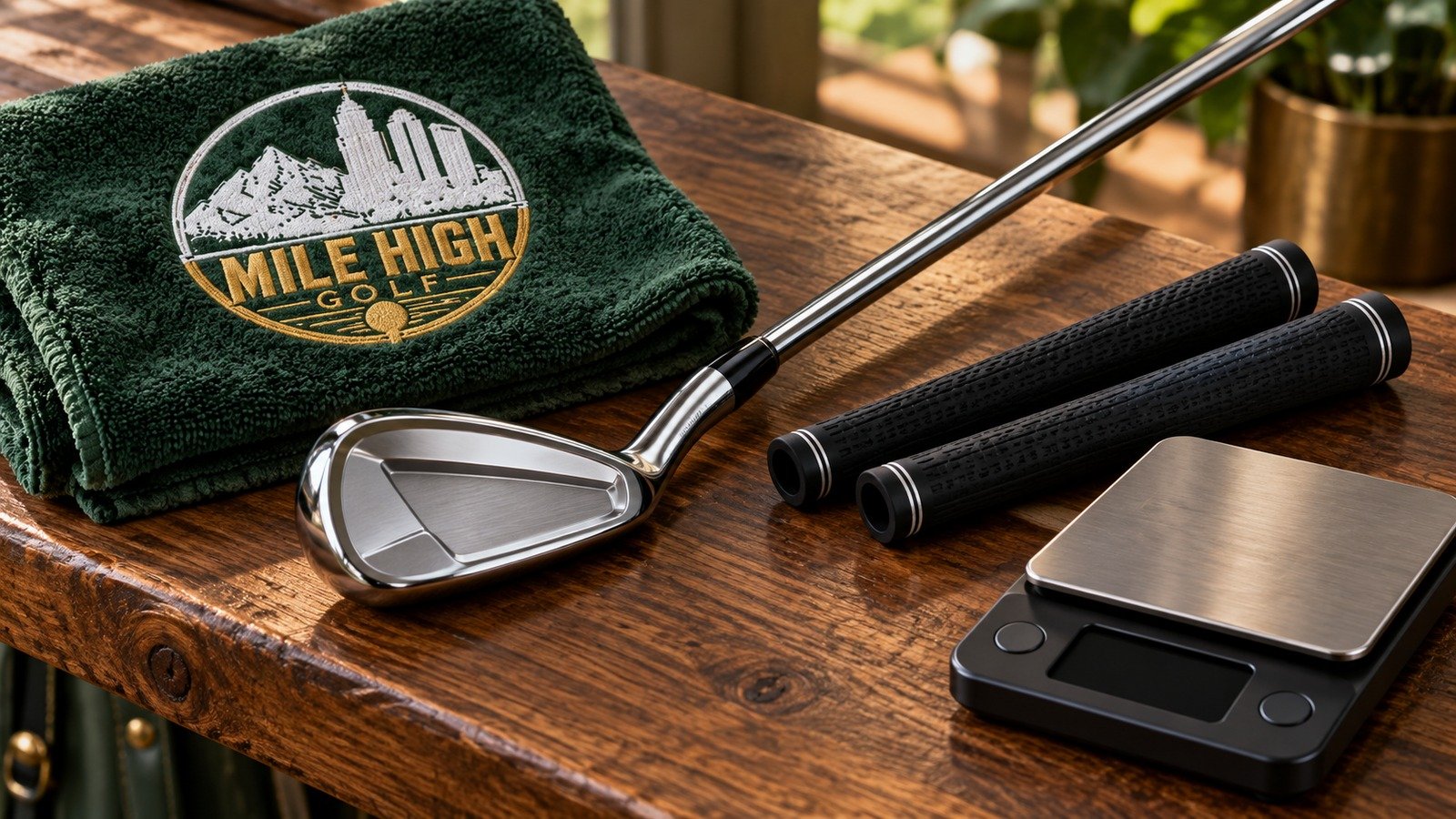
Two irons can weigh the same on a kitchen scale and feel different when you pick them up. Two clubs can also share the same swingweight label without feeling like twins. The apparent contradiction disappears once you separate total mass, balance, and the experience of swinging the complete club.
For golfers around Denver and Lake Norman, this distinction matters when a familiar club comes back from a regrip, a shaft change, or a length adjustment. “It feels different” is a useful observation. It is the beginning of an investigation, not a diagnosis and not proof that the work was wrong.
What the two measurements actually describe
Total weight is the mass of the assembled club, usually recorded in grams. Swingweight is a conventional balance measurement: it describes the club's static moment about a specified support point. The familiar letter-and-number reading is an index, not a weight in grams and not a direct measurement of the force you produce during a swing.
The GolfWorks' swingweight scale documentation identifies the standard 14-inch fulcrum principle and readings such as C8 and D2. That is equipment-manufacturer documentation of the measurement method. It does not prescribe D2, or any other reading, as the right fit for you.
Think about carrying a broom close to its bristles, then holding it at the far end of the handle. Its mass has not changed; its leverage relative to your hand has. A golf-club balance scale formalizes a related static comparison. Your hands and movement introduce more variables, so the scale cannot reproduce the whole sensation of a swing.
| Item on a build sheet | What it tells you | What it does not establish |
|---|---|---|
| Total weight in grams | Mass of the complete club | Where that mass is distributed |
| Swingweight reading | Balance on the specified scale | A universal feel or performance rating |
| Playing length | Measured club length using a stated method | Whether you can deliver it consistently |
| Grip model and measured mass | What is installed at the handle | Whether the grip fits your hands |
The same number can hide different builds
Imagine two clubs with different shafts and grips. A builder could change the head mass until both show the same swingweight. That does not make their total weights, shaft properties, or grip dimensions identical. They remain different systems even though one column on the worksheet matches.
The reverse also matters. Moving some mass toward the grip can lower a swingweight reading while increasing the club's total mass. Calling that club simply “lighter” loses useful information. Say whether you mean lighter on a total-weight scale, lower on a swingweight scale, or easier for you to swing. Those are three different observations.
Our shaft flex, weight, and torque guide covers other build variables. Read the specifications together. A balance label should help you describe the club, not erase the rest of the fitting conversation.
Why a regrip can change the reading
A replacement grip may differ in mass, size, taper, and texture. Tape and installation details are part of the assembled result. Because grip-end mass affects the balance measurement, a new reading does not automatically mean that the head became lighter or that something needs to be added to it.
Before asking a builder to restore the old number, compare the actual grips and record what changed. If the new grip helps your hands settle comfortably, preserving that fit may matter more than reproducing a historical scale reading. The correct decision still depends on how you deliver the club.
Avoid using a rough conversion chart as an exact work order. Component tolerances and the finished club matter. Our grip sizing and regripping guide explains the hand-contact decisions; balance measurement is a separate check that belongs alongside them.
Length changes deserve a complete measurement
Changing playing length changes leverage as well as where your hands sit relative to the head. Shortening a club and adding head mass until an earlier swingweight returns does not necessarily recreate the original club's behavior. It produces a new configuration that deserves its own evaluation.
Choking down can be a useful preliminary experiment, but your hands then contact a different part of the grip and some shaft remains above them. It is not an exact simulation of a cut, regripped, and rebuilt club. Treat it as a question to bring to a fitter rather than permission to start cutting.
What a careful bench check should record
A useful service conversation starts with the club as received. Record its identity, playing length, total weight, grip, and swingweight before disassembly where possible. Photograph the existing configuration if it will help distinguish later changes. If the original measurements were never taken, label them unknown rather than reconstructing a precise baseline from memory.
Follow the scale maker's setup procedure. In its digital scale instructions, GolfWorks describes separate weighing and swingweight modes, grip-cap placement against the stop, and special handling for gripless measurements. Those details belong to that instrument; other equipment should be used according to its own manual.
Ask for the final assembled measurements, not only the component targets. Dry-fit estimates and catalogue weights help planning, but they are not the same thing as a documented finished club. This is a recommended service-record practice, not a claim about work performed on a particular customer's equipment.
Compare feel with a question you can answer
Our suggested player check is deliberately modest. Warm up with a familiar club. Compare the candidate configuration in short groups, using the same ball and target. Record perceived effort, whether you can sense the head comfortably, strike consistency, and the resulting shot pattern. Return to the original configuration when a reversible comparison is available.
Do not judge by the single longest shot. A change that produces one excellent strike and several difficult misses has a different practical value from one that supports a repeatable pattern. If fatigue changes the comparison, stop and revisit it; adding more swings does not automatically add better evidence.
This is editorial fitting judgment, not a validated universal test. A qualified fitter can choose a comparison suited to your swing and the equipment available. Any internal weighting or structural modification should be assessed for compatibility and carried out with appropriate methods, rather than improvised to chase a number.
Leave with a build record, not a magic target
The useful outcome is a configuration you understand and can identify later: model, length, shaft, grip, total mass, balance reading, and the observations that supported the choice. Keep that record for future maintenance. “Match this documented build” gives a clubmaker more to work with than “make everything D2.”
Mile High Golf is coming soon. Explore the pro shop overview and join the founding list for opening updates. This guide does not announce available service appointments.
Primary equipment documentation reviewed September 28, 2026. Explanations and comparison routines are original editorial guidance; no customer measurements or performance gains are claimed. Hero image is an AI-generated editorial illustration, not a measurement demonstration or photograph of the facility.